 Baby Sleep



 The short answer



1Newborn sleep is supposed to be irregular
A healthy newborn may sleep many short stretches across 24 hours. The longest stretch can be much shorter than parents expect, and waking every 1 to 3 hours can be completely normal when feeding needs are high.
Official sleep-duration ranges are useful as population guidance, but they are not a diagnosis tool by themselves. A sleepy but healthy baby must still wake well enough to feed, breathe comfortably, maintain color and tone, and show appropriate diapers and growth.

2Day-night rhythm develops later
In the first weeks, circadian rhythm is immature. More obvious day-night organization often emerges over the next months as light exposure, feeding patterns, social interaction, and melatonin rhythm mature.
Parents can help gently by making daytime brighter and more interactive, while keeping nights dim, quiet, and practical. This is not sleep training; it is environmental support for a biological process that takes time.

3Safe sleep is the non-negotiable foundation
For every sleep, place the baby on the back on a separate firm, flat surface with only a fitted sheet. Keep pillows, loose blankets, bumpers, soft toys, positioners, weighted products, and inclined sleep devices out of the sleep space.
If the baby falls asleep in a car seat, swing, or carrier outside its intended use, move the baby to a safe flat sleep surface as soon as practical. Exhaustion is real, so set up the room before night begins.

4When sleepiness is a red flag
Too much sleep is concerning when it comes with poor feeding, difficulty waking, unusual limpness, abnormal breathing, blue color, fever, low temperature, worsening jaundice, dehydration signs, or fewer wet diapers than expected.
If something feels medically wrong, do not try to solve it with a schedule. Newborn concerns deserve prompt clinical advice.

Quick reference
Age
0-28 days
Newborn physiology is distinct
Sleep pattern
Short episodes
Often tied closely to feeding
Routine goal
Gentle cues
Light by day, quiet care at night
Avoid
Formal sleep training
Not appropriate for this stage


Example day
Morning
Age
Newborn physiology is distinct
Uses 0-28 days as context for the next plan.
First nap
Sleep pattern
Often tied closely to feeding
Uses short episodes as context for the next plan.
Midday
Routine goal
Light by day, quiet care at night
Uses gentle cues as context for the next plan.
Evening
Avoid
Not appropriate for this stage
Uses formal sleep training as context for the next plan.
Common challenges
Bedtime becomes harder after a late final nap.
 Bedtime becomes harder after a late final nap.
- Likely reason
- Sleep pressure may be too low or the last window may be off.
- Try first
- Protect the bedtime anchor and adjust the final nap.
- How to check
- Watch bedtime settling time for several evenings.
Night wakings increase suddenly.
- Likely reason
- Schedule, feeding, illness, development, or environment may have changed.
- Try first
- Review sleep, feeds, symptoms, and room conditions together.
- How to check
- Look for the same pattern across 3-7 days.
Plan for today
- 1
Use back sleeping for every sleep.
- 2
Keep the sleep surface firm, flat, separate, and empty.
- 3
Feed responsively and follow clinical feeding guidance.
- 4
Call a clinician for fever, poor feeding, breathing concerns, or unusual lethargy.
Quick routine checklist
How Yorix helps in the newborn stage
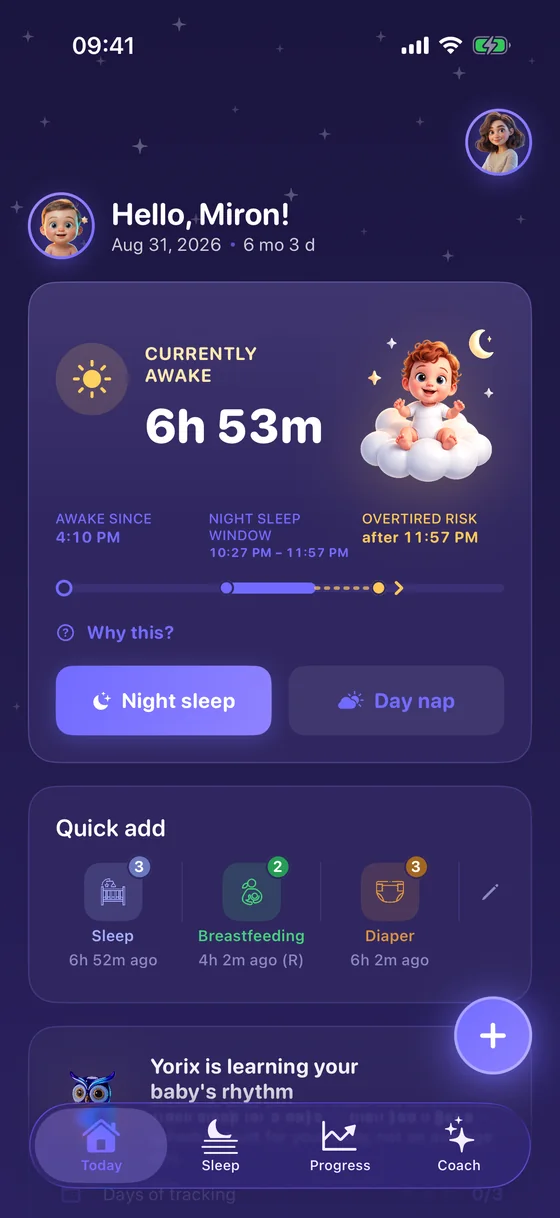
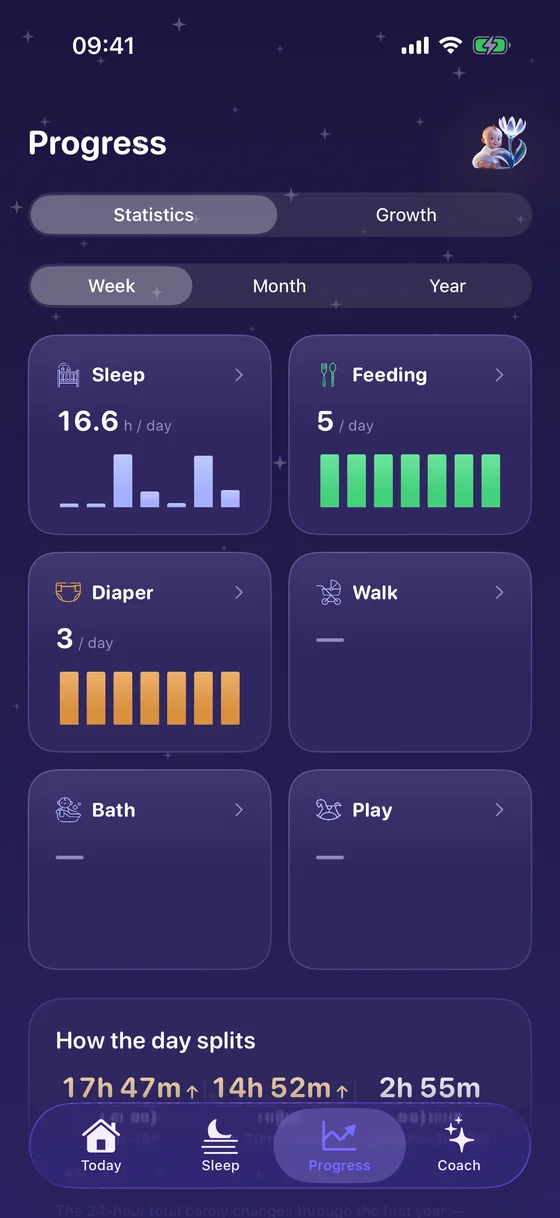
Yorix helps you track newborn sleep, feeds, diapers, mood, symptoms, and notes without pretending the first month should be perfectly scheduled.
The shared timeline makes caregiver handoffs easier and gives you clearer information if you need to ask a clinician about feeding, diapers, or sleepiness.
Common questions
Should a newborn sleep on a schedule?
A strict clock schedule is usually unrealistic. A simple rhythm around feeding, short wake time, safe sleep, and calm nights is a better goal.
Can I sleep train in the first month?
No. The first month is about safe sleep, feeding, recovery, and learning your baby’s signals.