 Routines



 The short answer



1Parent sleep is part of the safety plan
Exhausted parents are more likely to fall asleep in unsafe places, miss cues, argue about handoffs, or feel trapped by every waking. Protecting parent rest is not selfish; it is part of caring for the baby.
When possible, families can plan shifts, protect one longer sleep block for the most depleted caregiver, and prepare night supplies ahead of time. The exact plan depends on feeding, work, recovery, and available support.

2Reduce decisions in the middle of the night
Night stress grows when every waking becomes a fresh debate: feed or rock, diaper or not, wait or respond, move bedtime tomorrow or keep it fixed. A simple written plan lowers the number of decisions made while half-asleep.
The plan can be gentle: safe sleep first, feed when hunger is likely, keep lights low, use the same settling order, and write down what happened so nobody has to reconstruct the night from memory.

3Know when sleep advice is not enough
Fever in a young infant, breathing difficulty, blue color, seizures, unusual lethargy, poor feeding, dehydration signs, or concerning symptoms need medical advice. Parent thoughts of self-harm or harming the baby require urgent support.
No app or sleep method should override health concerns. The best routine tool helps organize observations so a clinician can understand what is happening faster.

4Make progress visible
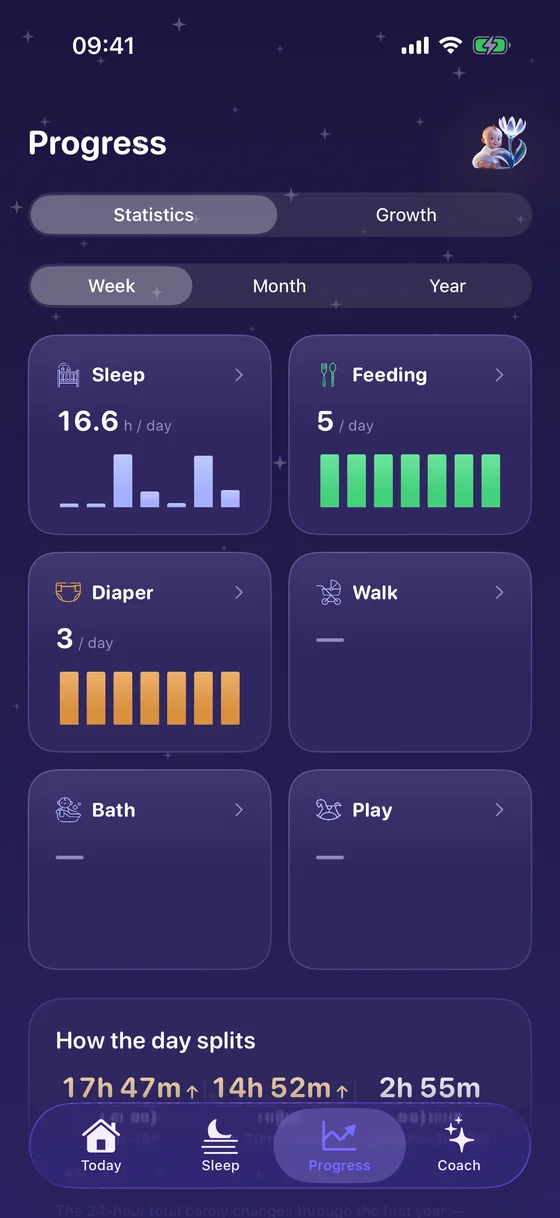
A hard night can make it feel like nothing is improving. Looking at a week of data often tells a more accurate story: a longer first stretch, fewer long wakings, a more stable bedtime, or better daytime naps.
Small improvements matter because family sleep improves gradually. Tracking helps parents notice progress before exhaustion erases it.

Quick reference
Main goal
Sustainable nights
Baby safety and parent recovery together
Best first step
Simplify the plan
Fewer decisions after midnight
Track
Sleep + feeds + mood
Patterns reduce blame
Red flags
Medical or mental health
Get urgent help when needed


Example day
Morning
Main goal
Baby safety and parent recovery together
Uses sustainable nights as context for the next plan.
First nap
Best first step
Fewer decisions after midnight
Uses simplify the plan as context for the next plan.
Midday
Track
Patterns reduce blame
Uses sleep + feeds + mood as context for the next plan.
Evening
Red flags
Get urgent help when needed
Uses medical or mental health as context for the next plan.

Common challenges
Bedtime becomes harder after a late final nap.
 Bedtime becomes harder after a late final nap.
- Likely reason
- Sleep pressure may be too low or the last window may be off.
- Try first
- Protect the bedtime anchor and adjust the final nap.
- How to check
- Watch bedtime settling time for several evenings.
Night wakings increase suddenly.
- Likely reason
- Schedule, feeding, illness, development, or environment may have changed.
- Try first
- Review sleep, feeds, symptoms, and room conditions together.
- How to check
- Look for the same pattern across 3-7 days.
Plan for today
- 1
Prepare night supplies before bedtime.
- 2
Agree on caregiver handoffs when support is available.
- 3
Track the night without judging one bad stretch.
- 4
Seek urgent help for baby danger signs or severe parent distress.
Quick routine checklist
How Yorix helps reduce parent stress
Yorix creates a shared memory for the family: sleep, feeds, diapers, growth, symptoms, and notes in one calm timeline. That reduces handoff confusion and the feeling that every night is random.
Daily summaries and AI guidance help you choose one next step instead of trying to fix the whole year of sleep at once.
Common questions
Can baby sleep problems affect parent mental health?
Yes. Fragmented sleep can worsen exhaustion and distress. Parents deserve practical support, not blame.
What if I feel like I cannot cope at night?
Tell another trusted adult and contact a healthcare professional or crisis service if there is any risk of harm. Sleep strategy should never replace urgent support.
 Turn insights into better days